
The Most Serene Republic of San Marino is a country completely landlocked as an enclave within northern Italy. Founded in AD 301, this microstate boasts a long and unique history as the world’s oldest surviving sovereign republic. Despite its tiny size, it has managed to preserve its independence, self-governing traditions, and distinct cultural heritage through centuries of regional upheaval.
History of San Marino
San Marino, officially the Most Serene Republic of San Marino, was founded on 3 September 301 A.D. It is considered the world’s oldest republic.
According to tradition, San Marino was founded by a Christian stonemason named Marinus the Dalmatian, who fled the island of Arbe to escape the anti-Christian Roman Emperor Diocletian. Marinus hid on the peak of Mount Titano and founded a small community of people following their Christian beliefs.
Its rugged isolation helped the enclave to develop and keep its independence. The country became a republic in the 1300s. An 1862 friendship and cooperation treaty with Italy, which has since been revised and expanded, reinforced San Marino’s independence.
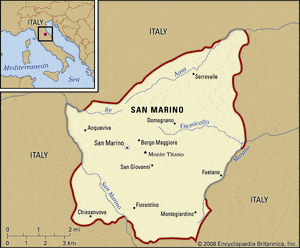
The land area of San Marino consisted only of Mount Titano until 1463 when the republic entered into an alliance against Sigismondo Pandolfo Malatesta, Lord of Rimini, who was later defeated. As a result, Pope Pius II Piccolomini gave San Marino the towns of Fiorentino, Montegiardino and Serravalle. Later that year, the town of Faetano joined the republic on its own accord. Since then, the size of the country has remained the same.
San Marino has been occupied by foreign militaries twice in its history, both for only short periods of time. In 1503 Cesare Borgia, known as Valentino, occupied the republic until his death several months later. In 1739, Cardinal Alberoni used military force to occupy the country, but civil disobedience was used to protest this, and clandestine notes sent to the Pope to obtain justice were answered by the Pope’s recognition of San Marino’s rights and restoration of independence.
In 1797, although Napoleon invaded Italy, San Marino’s situation was unaffected. Indeed, following the Napoleonic Wars, San Marino’s independence was recognized in 1815 at the Congress of Vienna.
In 1849, San Marino agreed to provide refuge to the famed Italian nationalist Garibaldi in defiance of Austrian forces In 1862, relations with Italy were consolidated by the signing of a customs union as well as a treaty of friendship and cooperation.
In 2026 the Association Agreement between the European Union and the Republic of San Marino went into effect. This treatry establishes a framework for integrating San Marino into the EU single market through the free movement of goods, services, capital, and people. After years of effort under the leadership of Minister of Foreign Affairs Luca Beccari, negotiations were formally concluded on December 12, 2023, and the EU Council authorized the agreement’s execution on July 16, 2026, leading to its formal signing on October 19, 2026. While this deal grants the microstate unprecedented economic integration, San Marino remains a sovereign nation and is not an EU member state.
San Marino Today
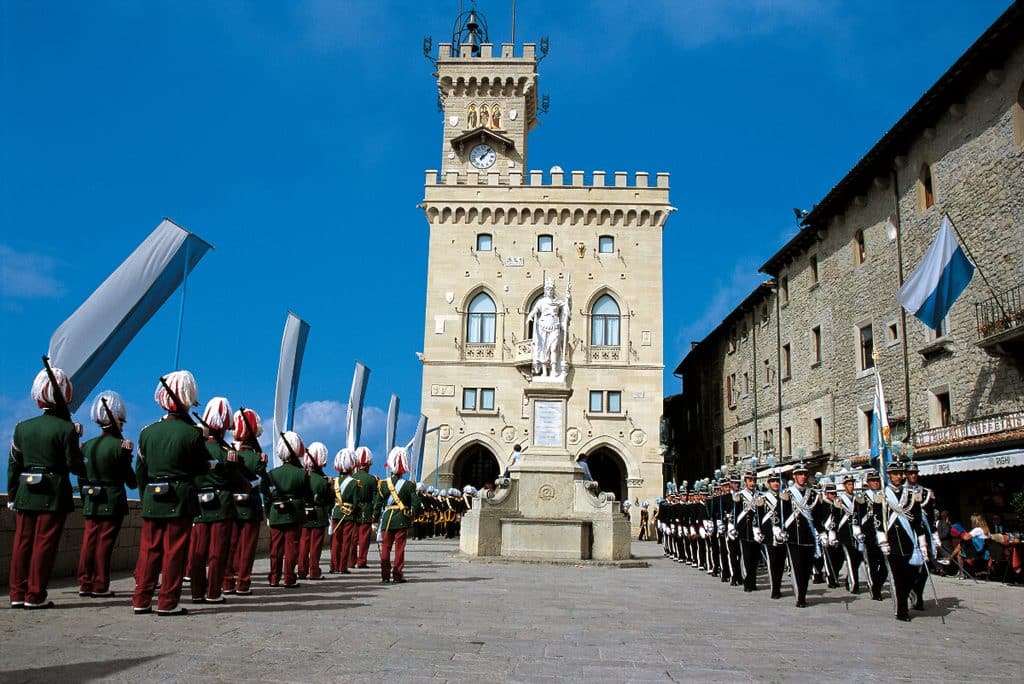
San Marino is a parliamentary Republic with two Captains Regent (Heads of State), who are elected for six month terms, and a Parliament composed of 60 members. The official language is Italian and the currency is Euro.
In 1988, San Marino joined the Council of Europe and four years later in 1992, the country became a member state of the United Nations.
One of San Marino’s chief economic activities is tourism, with visitors enchanted by its medieval streets, the amazing vistas of rugged cliffs and green valleys from its castelli, and the art and architecture of its churches. They might also enjoy eating local specialites like piadina and torta tre monte, shopping in the historic San Marino city center, or purchasing local wine, cheese, or honey from local farms.
San Marino Facts
Official Name: Republic of San Marino (Serenissima Repubblica di San Marino)
Language: Italian
Motto: Libertas (Liberty)
Founding Date: September 3, 301 AD (founded by Saint Marinus)
Size (Area): 61.2 square kilometers (23.6 square miles)
Size Rank: 5th smallest sovereign country in the world (5th smallest by area; 191st overall out of independent states)
Population: Approximately 34,000
Capital: City of San Marino (Città di San Marino)
Government Type: Unitary parliamentary republic, governed by two co-equal heads of state known as Captains Regent (Capitani Reggenti) who serve joint six-month terms
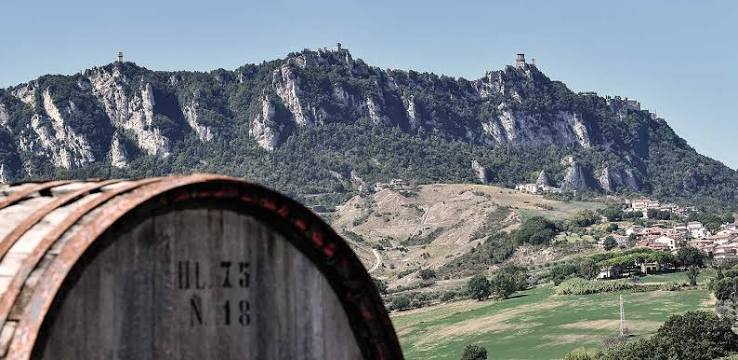
Geographic Landmark: Mount Titano (Monte Titano), a UNESCO World Heritage site and the highest point in the country
Currency: Euro (€), despite not being a member of the European Union (maintains official monetary agreements to mint its own national coins)